Tuesday, November 8, 2016

French Canada Trip: Day Two, Part One (Central Kentucky)

Click here to go back to Day One.

6:20AM, and I'm back on the road after a breakfast of biscuits and scrambled eggs. It felt like I hadn't stopped at all, that I'd just hit pause on the night, then play again after a few minutes of rest. But slowly the sky began to grow a dark navy blue as morning took its time over the Bluegrass state.


Kentucky is one of my favorite states to drive through. Beautiful rolling hills line every highway with quaint, white farmhouses peeking in on the hills and valleys. As I neared Lexington, I picked up a talk radio station devoted entirely to horse racing. An announcer discussed his early influences in between ads for Lexus of Lexington, Kentucky bourbon, and an upscale graphic design agency.


Interstate 75 bypasses the city of Lexington, but gives you a great survey of the land used to breed winning racehorses, something this region of Kentucky has long been famous for. In 1875, Churchill Downs, a horse racing track in Louisville, held the first Kentucky Derby. Before that, horse racing had been mainly based on the east coast. (think Belmont Park in New York and Laurel Park in Maryland) When New York state was the first state to ban gambling in 1821, many breeders and race enthusiasts who thrived on race betting headed to the hills of central Kentucky, where gambling was legal and land was plentiful and cheap.


The city of Lexington has gone through several measures in the past century to ensure that pastures outside the city remain intact. Mostly, they've mandated that tracts of green space stay open within city limits, requiring new neighborhood developments to adhere to their standards of land use and placement.


Dawn broke as I headed north, after skirting the eastern edge of Lexington. A golden sunrise cast shadows from mature oaks set against vast, open spaces. Gradually, the houses and exits dropped off once again, and the land stayed rural for the 83 miles from Lexington to the outskirts of Cincinnati.


Water towers were a signature sign of each town in northern Kentucky, so I soon made habit of snapping a picture each time one came into view.


Small towns dot the hilly landscape here, and most of the land is used to train horses. Homes are few and far between until I get closer to Cincinnati and the Ohio border.

Click here to read Part Two of Day Two, the long drive from Kentucky to Toronto.


Monday, November 7, 2016

French Canada Road Trip: Day One

So where do we start?

-a 228,000-mile Lexus IS300 with an oil leak, cooling problems, and at least three bent wheels
-enough clothing for three days, of a nine day journey
-a 2015 Rand McNally road map
-an earmarked list of 12 states, two provinces, and five major cities to visit along the way


This started at 4:30 on a Friday afternoon. I'd snuck out of work; they'd promised I could leave early, but I worked through lunch and left even earlier. It turned out to be a good call. The early rush hour build up meant I'd sit through slow traffic near the I75/575 split, but avoided the inevitable chaos that would hit full tilt if I'd waited thirty minutes later.

Soon I was through the jam, blasting by Lake Allatoona at a cool 78mph. I thought about what it meant to be at the beginning of a long journey. It never feels special at first. I was on a stretch of highway I'd seen dozens of times before. The exits were familiar, the rolling hills and gradual curves told me I was finally out of the sprawl, heading towards Calhoun and Dalton and Ringgold, foothill towns of the Appalachians which lie to the east.

It took me about 80 miles to start worrying. The car is wandering around all over the place, i thought. I started to worry about the ball joints. We replaced them about 15000 miles before, but I remembered one of the rubber boots missing after installing the new joints. I pulled over in Dalton under the golden skies of early evening.

Shoeless, I knelt down in the Walmart parking lot with phone in one hand, using it as a flashlight. Both rubber boots, which protect the front ball joints from corrosive elements, were in place. I moved down the road to an old automotive shop that had long since closed down. I called my dad, who I go to with all of my automotive questions. Carry on, was the gist of his answer.

First photo of the trip, an abandoned showroom in Dalton, Georgia.

My nerves were frayed from working. I knew I hadn't done nearly enough maintenance to the car to make the journey. There was still an oil leak somewhere, and very occasionally the car would tick above the center mark on the temperature gauge. And, probably least concerning, the 228,000 miles on the odometer when I set off on the journey.


Regardless, I kept going. 90 miles in, I reached my first state border, Tennessee. This was still a familiar site: the I75 and I24 interchange outside Chattannooga. One set of lanes takes you westward to Chattanooga, a second set takes you east towards Knoxville; that's where I was headed. The first of a nearly-endless forest of fall colors, which would stretch from Tennessee and through the rolling hills of Kentucky, all the way up to Michigan, and across through Ontario and Quebec, started here.

Leaves begin to ever-so-gradually lighten in southeastern Tennessee.

I75 from Chattanooga to Knoxville was a beautiful study in the rural, landlocked Volunteer State. Four lanes bounded up and down, a gentle roller coaster that drops you at various sites of Civil War significance along the way. It's hard to understate just how large of an impact that war had on this part of the country. Many lives were lost in those hills and valleys that I passed through, cruise still set on 78. After the war, cities like Chattanooga and Knoxville experienced huge booms thanks to the industrial revolution. But families living in between these big cities were still living very much in the 18th century. Flooding from the Tennessee River regularly wiped out these tiny communities, who lived in primitive, dirt floor shacks until the 1940s, when the New Deal brought dam-building to the region.

Today, the Tennessee River maintains a steady level thanks to dams and man made lakes, but it wasn't always that way. Instead of being left constantly subject to unpredictable floods, large areas of land became reservoirs, and remain as lakes today.

Eventually, I found my way to a truck stop outside of Knoxville. This would be the first of many truck stop meals on this trip, and my selection was as follows: Subway, Popeyes, or Pizza Hut. Opting for the least greasy option, I collected my sandwich and grabbed a window seat, where I could watch some of the patrons from the reflections in the glass. Most looked like they had been up for days. A few sat alone at two-person tables, but some seemed grouped together just out of utility, to be close--if even just in proximity--to another person for a few minutes. It was only 8PM, but I got the feeling that many of these folks, who I assumed to be truck drivers, were settling in for the night shift.

My final push for the day was a 70-mile stretch of highway from Knoxville to Williamsburg, Kentucky. I75 goes bang-up north from Knoxville, and elevation does as well. It's another rural stretch of Tennessee highway, with only eight exits spaced out between Knoxville and the Kentucky state line. Pitch dark, the route was lit only by my headlights bouncing off of the generous amount of reflectors on the road and guardrails. It's a beautiful stretch of pavement, winding through the Cumberland Plateau and passing through Rocky Top. That town, ironically enough, got the name only two years ago, when the city council of then-Lake City petitioned the Tennessee General Assembly to change the town's name.

Clouds form over a small community in northeastern Tennessee. This photo is from different trip I took to Michigan in 2015.

I caught the speed bug on this portion of highway, and wound the Lexus up to 80mph on cruise control. Luckily I wasn't the only one, and soon found a Ford Expedition on my tail, eager to get around. Someone who'd flush out the cops, as I've learned in my short history of driving. There were no police, and hardly any other cars traveling on the steeply-graded highway as the night went on. I cruised quickly and quietly to the Kentucky border. Eleven miles into Kentucky, I pulled off the highway, checked into my hotel, and called the night complete.

On night one, I stayed at the Cumberland Inn, a hotel run mostly by students from The University of the Cumberlands, whose campus was a few miles away in town. The Inn was built in 1991, and the effort was even mentioned by George H.W. Bush two years later, who commended the university's unique approach to bringing prosperity to the region. The front desk is staffed 24-hours, there's a pool, spa, restaurant, museum, and conference center on the grounds, and a standard room runs under $100 per night. I rested easy, even in anticipation of the long day of driving that lay ahead of me.


The Cumberland Inn, furnished in appropriate, albeit dated fashion. It certainly looks like Kentucky, with its commanding pillars and brick exterior, and classic interior complete with chandeliers and a grand staircase.
I've got a long day ahead. Day Two, Part One takes us through Kentucky, and on towards Toronto.

Sunday, October 2, 2016

An Evening at the 2016 Petit Le Mans

One of 1,963 50th Anniversary 911s built, this Porsche makes a statement overlooking turns 11 and 12 at Road Atlanta. (Brooks Metzler 2016)
Campground craft take multiple forms. As it turns out, one of these is a convertible Chevy sedan. There's no arguing; the patina is perfect. (Brooks Metzler 2016) 
A classic long wheel base Range Rover flexes for the camera in the Road Atlanta infield during the 2016 Petit Le Mans. (Brooks Metzler 2016)

Members of Ferrari team Risi Competizione stand on the pit wall, awaiting their turn in the 488 GTE. (Brooks Metzler 2016)

Ford Racing's team tent in the paddock on pit lane. (Brooks Metzler 2016)
A replacement front bumper for the Ecoboost Ford GT sits on top of a toolbox by the Ford team. (Brooks Metzler 2016)
An Audi R8 V10 pace car was the subject of a lot of attention at the far end of the paddock. (Brooks Metzler 2016) 
The No. 4 Z06.R of Team Corvette powers out of turn one at Road Atlanta. (Brooks Metzler 2016)
The No. 68 Ferrari 488 GTE of Scuderia Corsa, which went to take home 8th in the GTLM class. (Brooks Metzler 2016)
No. 8 Audi R8 LMS GT of Stevenson Motorsports negotiates turn 10 at Road Atlanta. Finishes 6th in the GTD class. (Brooks Metzler 2016)
Ford Chip Gnassi Racing's GT No. 67, which went on to finish 7th in the GTLM class. Its twin, No. 66, finished second in class, bested by Risi Competizione's Ferrari 488 GTE. (Brooks Metzler 2016)


An offering from local manufacturer Panoz at Road Atlanta. Out of frame, their DeltaWing prototype is loaded into the trailer. (Brooks Metzler 2016)


A BMW M4 GTS at the manufacturer's booth on vendor hill at Road Atlanta. (Brooks Metzler 2016)
BMW race cars line up underneath the vendor awning at Road Atlanta. (Brooks Metzler 2016)
A trio crosses under the bridge as the sun starts to duck behind the trees during the final hours of the 2016 Petit Le Mans. (Brooks Metzler 2016)
A group barrels down the hill towards the fast final corner at Road Atlanta during the 2016 Petit Le Mans (Brooks Metzler 2016)

Ferrari and Ford round the final corner before the straightaway. (Brooks Metzler 2016)

Change Racing's Lamborghini Huracan GT3 rounds turn three at Road Atlanta, followed by the red and silver Huracan of Paul Miller Racing, which ultimately finished ahead. (Brooks Metzler 2016)

A Chevrolet fan watches the 2016 Petit Le Mans action across from the grandstands on turn 10. (Brooks Metzler 2016)

The No. 66 Ford GT of Chip Ganassi Racing, which went on to finish second in the GTLM class. (Brooks Metzler 2016)


The No. 60 Honda HPD of Michael Shank Racing, which won first overall at the 2016 Petit Le Mans, while also setting the best lap time of the day, at 1:13.5. (Brooks Metzler 2016)


Team Seattle Racing's 911 GT3R and Change Racing's Huracan GT3 are door-to-door leaving turn one. (Brooks Metzler 2016) 
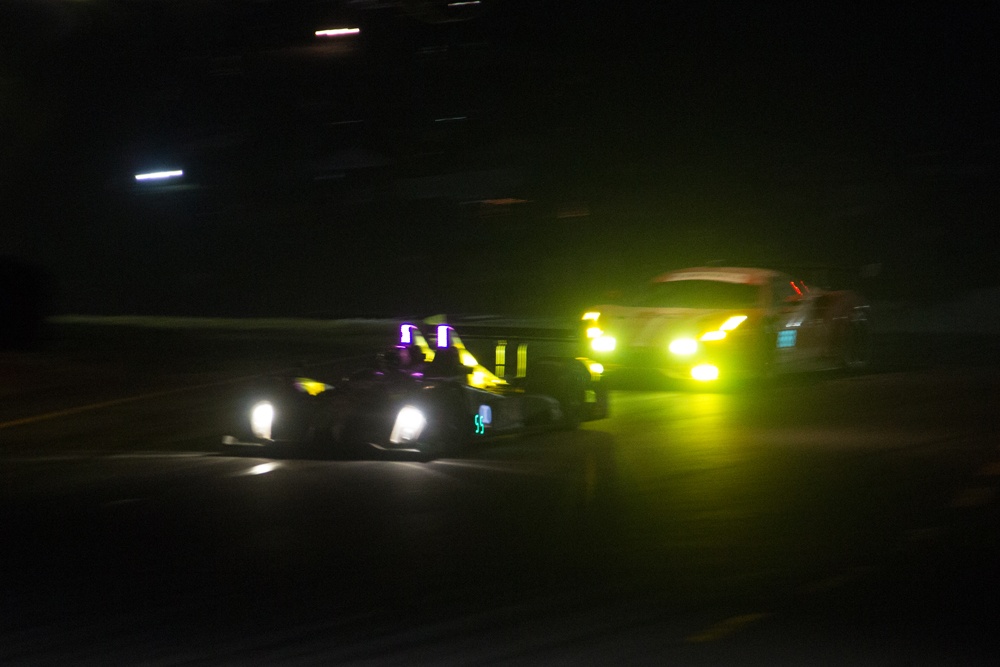
All four discs glow red on a Mazda Prototype as night falls on Petit Le Mans. (Brooks Metzler 2016)

Porsche North America prepares to pack up their 911 RSR early. They finished 10th in the GTLM class. (Brooks Metzler 2016)